Angela Piehl
Associate Professor / Area Head, Painting & Drawing
Department of Art & Design, Peck School of the Arts
University of Wisconsin, Milwaukee
Compression Portals


Pieces in the series include small graphite drawings on paper, each 9 inches x 9 inches in scale.
Depicted above, Top left to bottom right:
Compression Portals 1-8, 2025.
Compression Portals is a series of small graphite drawings on paper, each 9in x 9in. Much like the collages seen in Portals, Planets & Petri Dishes, this series also references the portal and petri dish, implying a sample taken from a larger ecosystem, as well as a pathway. Each drawing presents a compressed, self-contained world, seemingly isolated, but capable of growth-- like a seed bomb. Imagery within each composition includes conglomerations of elaborate yet abstracted elements, introducing strange new forms and communicating as a potent bundle, or a chipped away chunk from a larger amalgamation.
As in the collaged spherical pieces, these works contain allegorical and narrative allusions that address our material relationships as humans, ecological fragility, and mankind’s precarious situation within that ecology. This layering of visual content gives viewers multiple access points through glimpses of recognizable elements. At the same time, it challenges viewers to relate to the seemingly familiar in new ways. Drawing mediums emphasize aspects of observation from scientific eras before the camera was a useful tool, as well as a form of observation requiring interpretation.
Queer Compost


Pieces in the series include small graphite drawings on paper, 17 inches x 14 inches in scale, 14 inches x 11 inches (vertical) or 11 inches x 14 inches (horizontal).
Depicted above, Top left to bottom right:
Compost Burl, Compost Bulge, Compost Vortex, 2022.
Select works depicted in Queer Compost and Tumbles echo ideas seen my painting work. Compositions merge broadly ranging elements into hybrid forms. Imagery in my drawings employ pattern, and textural artifice proliferating in corporeal forms. These amalgamations exist in ambiguous spaces, where the synthetic and organic overlap in unexpectedly. Forms suggest a future where nature has either overtaken, or merged, with the human made. Compositions are engaging and seductive, while also repellant and abject.
Drawing on entanglements and unexpected visual juxtapositions, my work engages with Donna Haraway’s ecological notion of “hot compost piles.” The collage aesthetic materially recycles found images and elements, reshaping them into something new. Metaphorically, the icons, symbols, and ideas of visual culture can themselves be composted—broken down, remixed, and allowed to cross-contaminate in ways that generate fresh interpretations.
Compost, as a queer ecological notion, resists purity, hierarchy, and linear progression. It is an unruly mixture where boundaries blur, where decay and growth coexist, and where identities, materials, and meanings intermingle without fixed outcomes. In this sense, compost becomes a site of queer possibility: a space that welcomes hybridity, transformation, and the unexpected. It models a world in which materials and beings are constantly becoming-with one another through processes that are collaborative, messy, and generative.
The terrain depicted in this work becomes a site of such potential—akin to compost, a continuously shifting substrate in which a prolific range of transformations can occur. Through collage aesthetic, I explore ecological thinking, speculative fabulation, and the queering of nature, engaging with the proliferating entanglements of both natural and synthetic worlds. In doing so, I reflect on the afterlives of consumer materials, their legacies, and their visual cultures, imagining how they might decompose, recombine, and flourish differently in a queer ecological future.
Tumbles


Pieces in the series include small graphite drawings on paper, 10 inches x 7 inches (vertical) or
7 inches x 10 inches (horizontal).
Depicted above, Top left to bottom right:
Tumble 1-5, 2013.
Lonely Hunters


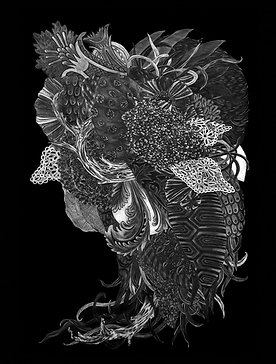
Depicted above, Top left to bottom right:
Chandelier, Shivaree, Imperious, Beetle, Chimera, Nest, Helmet, Ex-Voto, 2010-2015.
Lonely Hunters is a series of colored pencil drawings on black paper, featuring abstract accumulations, and creature-like hybrids of flora and fauna, in dark environments. The drawings reference memorial bouquets, and traditions of mourning such as Victorian hair jewelry and jet jewelry craft. Jet jewelry ornaments were fashioned from black vulcanite or compressed coal. It was a particularly private and intimate form of mourning to keep a lost loved one's hair, and fashion the material into a bouquet or bracelet or other form of adornment to express love, grief and devotion. Each piece held meaning as a memento, and a brooch could convey a message symbolized through flowers, hands, weeping willows, or other forms.
I quote this practice for its beauty and sentiment, mourning a lost connection to nature while crafting new speculative forms. Exploring aspects of gender through lush, baroquely queer embodiments, the overall abstraction in this series belies specific invocations of materials: hair, feathers, fabric, pearls, petals, and honeycomb, which are rendered in curves, bulges, folds, and florid shapes.
The title, Lonely Hunters, references the Southern Gothic literary genre, and like characters within the genre, the forms or creatures depicted in these drawings are solitary– at once seductive and repellant, grotesque and beautiful. Pieces in the series include both large-scale and mid-sized drawings, ranging from 38 inches x 56 inches in larger works, to 30 inches by 22 inches in mid-sized works.
Relevant Series of Earlier Works:
Creatures of Excess


Pieces in the Creatures of Excess series are 50 inches x 38 inches, and 30 inches by 22 inches.
Depicted above, Top left to bottom right:
Crowning, Surge, Moribund, 2009-2013.
Feral Bouquets


Pieces in the Feral Bouquet series are 14 inches x 11 inches (vertical) or 11 inches x 14 inches (horizontal)
Depicted below, Top left to bottom right:
Feeler, Shield, Cabochon, Grapnel, Bone Caboch, Bloom, Tuft, Caruncular, 2011.