Angela Piehl
Associate Professor / Area Head, Painting & Drawing
Department of Art & Design, Peck School of the Arts
University of Wisconsin, Milwaukee
Permeable Shapes


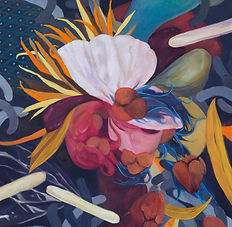
Permeable Shapes is a series of oil paintings on panel. Compositions are constructed through alternating processes of drawing from preliminary collages, then layering paint intuitively in order to produce a space that feels evocative of both the collaged histories of the imagery, and a living, continually transforming environment. Through the merging of broadly ranging elements, I create hybrid forms that exist in ambiguous spaces within the painting, where the synthetic and organic overlap in unexpected ways. These forms suggest a future where nature has either overtaken, or merged, with the human-made.
Influences for my paintings include compost piles, cast off cuttings from collages, and other visual references which allow for a merging of aesthetic orders, prompting a mixture of natural and human-made proliferations seen in the work. Employing entanglements, and unexpected visual collaborations and combinations, I am interested in Donna Haraway's ecological thoughts on "hot compost piles", as well as her theories on speculative fabulation, and multi-species worlding. Speculative fabulation merges fictions and non-fictions, and practices of world-building in order to better consider multiple and non-human viewpoints. This shift from the human-centric perspective fosters inter-connectedness, encouraging us to envision and create better futures, full of "creatures of the imagination". I apply a version of speculative fabulation to my painting process through collage, and with an aesthetic that echoes composting.
I title the series Permeable Shapes in a nod to the fragmentary, abstract, and intuitive experience that Merleau-Ponty summarizes as a kind of pre-language perception. Perceiving is grounded in having a body, which in turn inhabits a world. The world around us is endlessly transforming, and we are also in constant metamorphosis within our bodies, as we experience the world. However vague or permeable the boundary may be between the body and the environment, it cannot collapse entirely, and yet it is a space of infinitely layered possibilities. In our bodily capacities and dispositions, perception grounds the basic forms of our experiences and understandings within our bodies, and we attempt to interpret through orientation, figure/ground, focus and horizon. This feels particularly conceptually applicable to speculative fabulation, as well as to making and looking at paintings.
I utilize collage aesthetic in a gender-queer mode, in an ecological mode, and in resistance of an easy legibility. There are moments that create questions for the viewer and ask the viewer to categorize and figure out where the original material is coming from, and why it might be pointed out. But there is also an effort to not obliterate the varieties and variations of beauty that are possible, as well as the sense of mutability happening within the compositions. Exhuberance in my work occurs through depicting accumulations of brightly colorful and adorned "bodies" in constant transition-- alternately understood as permeable/impermeable, sedimenting/spontaneous, positive/negative, fragmentating/fusing, foregrounding/backgrounding, visible/invisible. Perception is left open to the viewer to actively shift ideas of power, and shift ideas about the surrounding world. I find this openness subversively beautiful, queer, and potent with possibilities and considerations.
Each painting in Permeable Shapes is 48 inches x 36 inches (horizontal orientation) or 36 inches x 48 inches (vertical orientation)
Depicted above, Top left to bottom right:
Permeable Shapes, 1-5, 2025.
Feral Beauty


_edited.jpg)




_edited.jpg)


Paintings in Feral Beauty are painted in oil on panels. Paintings range from small paintings sized at 8 inches x 10 inches, 12 inches x 12 inches, mid-sized works at 18 inches x 24 inches (horizontal orientation),
24 inches x 18 inches (vertical orientation), 24 inches x 24 inches, and
one large-scale work at 36 inches x 48 inches.
Depicted above, Top left to bottom right: Fishtail, Deep Locus, Flagging, Licker, Hoard, Clusters 1-4,
Hum, Frond, Elegy, Ingress, and Expulsion, 2015-2025.
Select works depicted above are from Feral Beauty, an ongoing series of oil paintings made between 2015 and the present. Like my drawing series Creatures of Excess and Feral Bouquets, these paintings fuse a wide range of visual elements into hybrid, unruly forms. I employ color, pattern, and textural artifice to generate corporeal proliferations—forms that seem to grow or bloom beyond their expected boundaries. These amalgamations inhabit ambiguous spaces where the synthetic and the organic intermingle and become difficult to parse. In these works, the forms hint at a future in which nature has either overtaken or merged with the human-made, forging new ecologies that trouble distinctions between bodies, objects, and environments. Their surfaces aim to be alluring and sensuous, even as they border on the repellant and abject.
Compost offers a model for thinking about matter—and meaning—as something perpetually in flux: breaking down, recombining, metabolizing, and generating new life through mixture. This queer ecological logic resists linearity, hierarchy, and binary thinking; it values the exuberant, abundant, and unruly. In my paintings, I adopt this logic by allowing forms to evolve through the deliberate mingling of incompatible textures. The painting surface becomes an active zone where imagery mutates in ways that challenge normative ideas of beauty, nature, and embodiment. It is a place where new ecologies can be imagined, in which the boundaries between creature and object, flora and artefact, human and nonhuman are continuously undone and reconfigured. In this sense, the work participates in a larger inquiry into how visual cultures, consumer materials, and environmental imaginaries might decompose and reassemble differently, giving rise to forms of life that are less about stability and more about ongoing, generative transformation.