Angela Piehl
Associate Professor / Area Head, Painting & Drawing
Department of Art & Design, Peck School of the Arts
University of Wisconsin, Milwaukee
MA/MFA Candidate Research
Steph Seigman
MFA 2022
Through new-media hybrids of drawing, loops, time-based media, and printmaking, a futuristic world is actively building itself through successive piece. The future world(s) depicted in this body of work are a reflection of contemporary conversations. Construction of this societal mirror is references are joined by repeated motifs: smoke, architecture, figure, and pipes.
Each of these elements have a flexible symbolic meaning that serve to connect the works together. The work speaks to how we are reflected in our visions of the future and what it says about us. Additionally, moving between these universes and the subjectivity of shifting relationships are explored. The body of work references the tradition of fantasy illustration and music subculture. Binding the breadth of the work, loops and static images produce narrative building blocks of the world.
Someplace Stolen embodies the consequences of capitalism through speculative fiction and imagines alternative futures through ecologically queer thinking and world building. I produced an extended animation loop with audio, five prints and a soundscape that depict zombie-like mechanical statues, billowing smoke, scorched-red skies and interventions into the human figure.


Joel Butler
MFA 2023
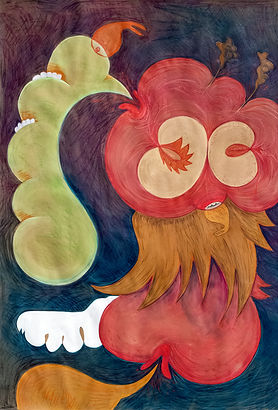
Pantheon is twelve mixed media art-plays on paper inspired by the twelve Olympians. The catalyst for Pantheon is a body of exercises at the core of my studio practice using the Surrealist technique of automatic drawing. Through automatism, drawing is primary to ideation, as opposed to the more common other-way-around. By keeping the drawing implement moving I disable measured, rational thinking, which keeps intentionality from interfering with the creative process. While performing a trance-like dance with my drawing movement my temporal experience is altered.
For Pantheon , I arrange and replay those automatic drawings in a slower, non-automatic state of mind. It is with a back and forth between automatism and remix that I develop these larger pieces. The primary drawing implements I use are watercolor crayons and acrylic markers that both feel in hand the same as wax crayons and ink markers did as a child. By using these materials, I reconnect with how I felt as a child artist, before being influenced by artistic conventions. This grounds me firmly in a space of childlike play. In this space, I embrace “mistakes, ” anarchically evolving my visual language in new directions, a constant state of becoming, unfiltered by the rational mind.
Taking inspiration from the excesses of those original deities I explore sexuality, sensuality, and scatology to queer the boundaries of normative culture. I created each of the twelve beings in Pantheon with the notion that they can exist in their own universe with its own idiosyncratic visual and conceptual rules. Within these universes, I subvert various antinomies through the act of play. I ambiguate two- and three-dimensional space, figuration and abstraction, transformation and stasis, beauty and the grotesque, masculine and feminine, the worldly and the ethereal.



Steffon Dixon
MFA 2023
My creative practice is an exploration of identity and culture, mostly through portraiture and poetry. I have come to understand that as a Black man, there are realms that I may exist in, in which, my existence can bring forth questions about how I fit into the world.
The art world can exude exclusivity.
My work begins with the question: “What does it mean to be Black?” Through this inquiry it became apparent to me, being Black is no monolithic experience. My portraits have become a meeting place between my subject and my investigation of their existence. My work starts there. Through portraiture paired with conversations, I have tried to explore what it means to be Black in the fullness of the experience -- its challenges, its joys, and its contradictions. My paintings are the manifestation of these exchanges -- an expression of the complexities of our common existence.
I produce art that documents the story of the people I portray: their voice and image, their introspection into Black culture. Beyond painting and poetry, there are conversations and community engagement. These relationships and connections are the foundations of my work. To convey the authenticity of someone’s story, I find myself producing work that simultaneously highlights the real and the “rough” of the person. The subjects of my work are expressive. The painted spaces they exist in are colorful, decorated, and rugged. The surface of the work is constructed in such a way that the imperfections which dress the plane are both covered and highlighted. The authentic essence of a person exists somewhere in between the image they project to the world and the bruises that the world has inflicted upon that image. I choose to portray them at this encounter.
I would like to imagine these works as proof of our existence and vehicles for remembering some of the stories we shared. They are the artifacts that hold the evidence of a conversation -- birthed from personal exchanges, but also rooted in a larger discourse about the state of Black culture in America. These works are born from statements with a goal of them being statements in themselves. I use my studio as a study room to explore an understanding of myself and the people who look like me. The result is the rendering of a proof of existence.


Barbara Miner
MFA 2023
I grew up in an era when Milwaukee rightly deserved the title “Machine Shop of the World.” Manufacturing industries employed tens of thousands of people, and the Pabst, Miller, and Schlitz breweries “made Milwaukee famous.” Beginning in the late 1970s, however, companies shipped jobs to non-union plants in the South, and then overseas. Factories were replaced with strip malls, office buildings or apartments. Family-supporting union jobs were replaced with low-wage and/or part-time jobs.
The photograph portraits that follow are part of my multimedia project, Shadows of Industrialization. The project centers on contemporary photographs and audio interviews with former industrial workers and current workers in service industries. Because the project is also the story of Milwaukee, the portraits were taken in locations that speak to the region’s history — from Allis Chalmers in West Allis, now primarily a shopping mall, to the rubble-strewn, empty parking lots of A.O. Smith in the central city.
Shadows of Industrialization stems from my long-standing attempt to figure out the complexities of my hometown, a metropolis too often reduced to slogans such as “a great place on a great lake.” I grew up in Milwaukee in the 1950s and 1960s, was gone for about 20 years, and returned to be with family and to raise my children. But it was not the city of my youth. Deindustrialization, the most significant change, had forever changed the city. Milwaukee powerbrokers had always been complicit in the entrenched racism that earned the city the moniker “The Selma of the North.” But, during the decades following World War 2, there were good jobs in manufacturing that made Milwaukee one of the best places in the country to raise an African American family. Those jobs by-and-large disappeared, and today Milwaukee is considered one of the worst cities for African Americans. White flight, the lack of public transit and suburban housing codes, meanwhile, have so heightened the region’s segregation that a new description has been needed — “hyper- segregation.”
We live in an era of uncertainty and the way forward is not clear. I think back to my interview with Anthony Rainey, who worked for Master Lock for 23 years and recently retired as a union rep for the United Automobile Workers. “We can’t make any advances alone,” he said. “But we can help each other make advances together. It takes time and it takes effort. Nothing worthwhile is easy.”


Allison Calteux
MFA 2023
Remnants // relics // remembrance is a commemoration of familial lineage towards the future through the traces of the past of my ancestors. The archive of objects and photographs they left behind are brought into the present through my photographs; self-portraits and still lifes revealing interactions with the books, jewelry, and images that remain posthumously.
By wearing my ancestors’ jewelry, posing alongside their photographs, and incorporating my own objects and images into the archive, I am reintroducing embodiment to absence. Photographing these interactions becomes a part of a ritual in which I explore my own place in time and practice remembrance towards the future. Engaging with the contents of the archive brings the belongings of my ancestors into the present to be reimagined as relics.
These everyday objects become symbolic stand-ins for my ancestors and are presented with reverence. Within this archive, I choose to pay homage to the women in my family – those who are pictured, those whose belongings have been passed down, and the one whose photographs are a part of this work. As equal parts archivist and artist within this body of work,
I am assembling a history so that I may become a part of it one day.
Printing images from this inherited archive as cyanotypes and capturing my own performances on film references both historical and contemporary photographic practices which parallels the historical and contemporary timelines within each piece. Through this work, I am creating a record of my own life in conversation with the past and aligning my photographs with those within the archive. The creation of this work is imbued with a melancholic recognition of my own mortality, while the process of archiving provides a method of self-preservation. This merger of the past and present allows me to consider what traces of me will exist within a future archive: a future where the photographs, jewelry, and handwritten notes of today are remnants to be rediscovered.


Lilly Dyer
MFA 2024
Don’t Change That Channel is an immersive world of queer possibilities, inviting the viewer to engage through play and performance. In this installation, I use the photoshoot process to create a space for queer people to act out a fantasy or identity that might feel inaccessible to them. By referencing icons from popular culture, the photographed queer body challenges a visual narrative of normativity. Through embodying a character, subjects queer the conditions of their own in/visibility by performing acts of photographic dis/appearance. They playfully queer the pop culture icons through performative gestures, props, and costumes. Then, using digital manipulation, components of photographs are fabricated in post-production, furthering the narrative’s facade.
As the viewer moves through, photographs and sculptural objects form immersive sets and lines are blurred, transforming the viewer into a performer. This allows the body to exist within a space where logic is reinvented, paused, or reversed; and what we think we know, and how we think things should be, is now undone. The sets are theatrical and kitschy, while sculptural replicas are exaggerated in size and color acting as a framework for the viewer to play along.


Laura Bennett
MA 2025
My work explores the intimate relationship between space and form, beginning with ordinary shapes found in my garden. Drawing from landscape, still life, and abstract traditions, I recontextualize familiar forms and spaces through luminous veils of color and broken lines. This process disrupts habitual ways of seeing—blurring boundaries between plants and their environment, while inviting engagement with texture, ornamentation, and visual ambiguity.
A garden is a space that is both cultivated and wild, shaped by passage, pause, and unscripted encounters. I capture these fleeting moments in egg tempera under the soft, fading light of evening, allowing what I see to easily slip away. My gaze transcends order, blurring distinctions between plants, their surroundings, and me. Paintings are improvised, incorporating material traces of the environment itself: gnats, grass stalks, mud, leaf fragments, and even pieces of my own body. In Maurice Merleau Ponty’s words, "The body is both the soul’s native space, and the matrix of every other existing space." I paint from a location of reciprocity and permeability, where perception, presence, and place are in constant exchange.

